
String Inverter vs Microinverters vs Optimizers
August 29, 2026
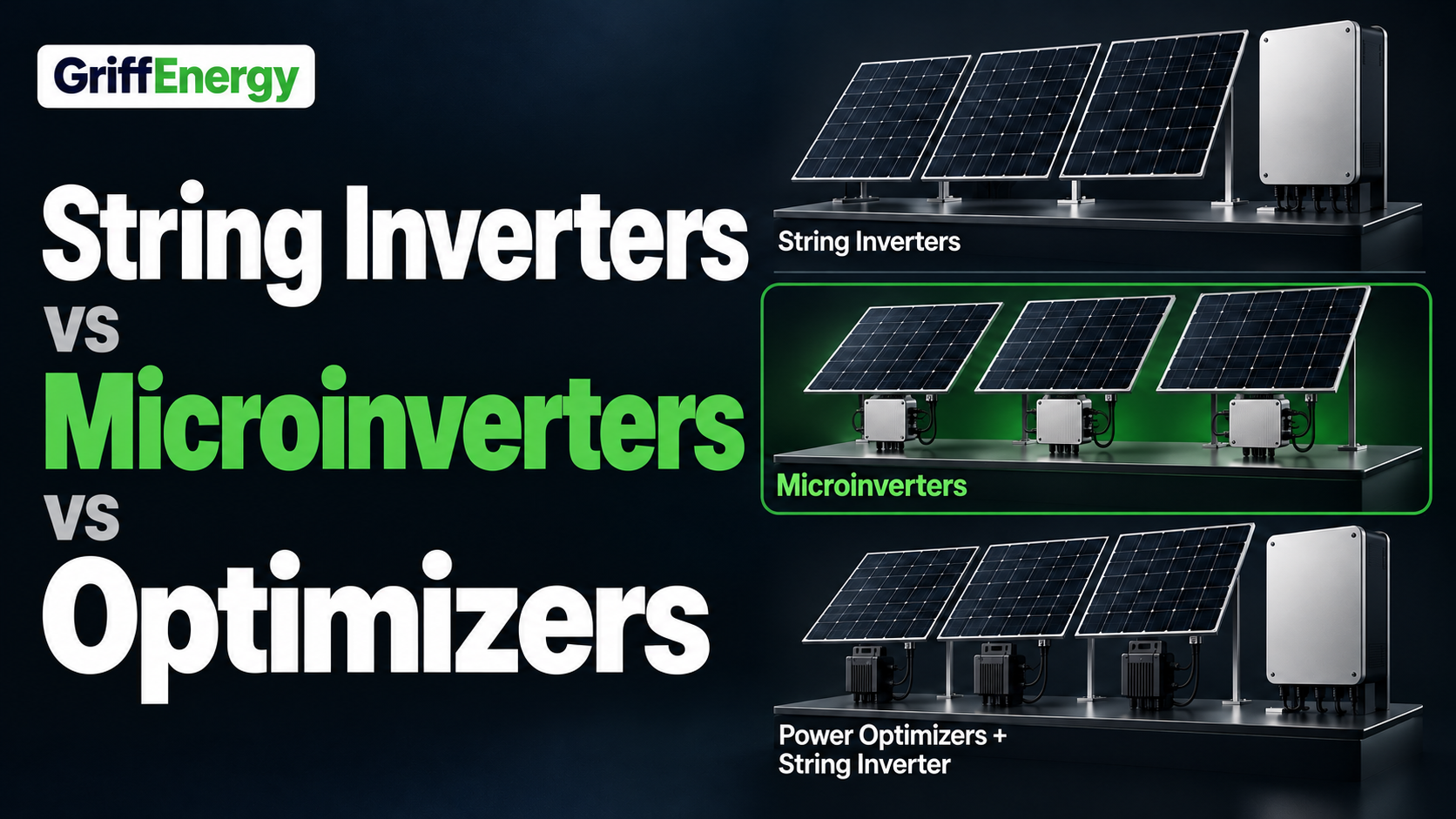
A string inverter is cheapest and fine for a simple, unshaded roof. Microinverters or optimizers earn their premium when you have shading, multiple roof faces, or want panel-level monitoring. The inverter is also the component most likely to need replacing during the system's life.
Panels get all the attention, but the inverter shapes how your system performs, how it fails, and what it costs to maintain. There are three approaches, and the right one depends mostly on your roof.
| String inverter | Microinverters | Optimizers | |
|---|---|---|---|
| Where it sits | One unit, usually in the garage or basement | One per panel, on the roof | One per panel, plus a central inverter |
| Shade handling | Weakest panel drags the string | Each panel independent | Each panel independent |
| Monitoring | System level | Panel level | Panel level |
| Cost | Lowest | Highest | Middle |
| Serviceability | Ground-level swap | Roof access needed | Roof access for optimizers |
One unshaded roof plane, panels all at the same orientation and tilt, no plans to expand: a string inverter does the job for less money and is the easiest component to service because it is mounted at ground level. The trade-off is that panels are wired in series, so the weakest performer sets the pace for the whole string — one shaded module pulls the others down.
Microinverters and optimizers both make each panel perform independently. That matters if you have a chimney, dormer, or tree casting shade for part of the day, panels split across multiple roof faces, or you simply want to see which module is underperforming. Panel-level monitoring is genuinely useful over a 25-year life — it turns “output seems low” into “panel 11 is the problem.”
Panels commonly carry 25-year warranties. Inverters usually do not — central string inverters are frequently warranted around 10 to 12 years, so a replacement partway through the system's life is a reasonable planning assumption. Microinverters typically carry longer warranties (often around 25 years), but replacing one means getting back on the roof and lifting a panel. Neither approach is maintenance-free; they just fail differently and cost differently to fix.
Get the make, model, and warranty length for the inverter in writing, and ask specifically: how many years is the inverter warranted, is labour included in a replacement, and what does a swap cost out of warranty? An installer who cannot answer those three questions crisply is not the one you want maintaining your system in year 12.
Panel-level electronics help when snow clears unevenly, since partially covered panels do not drag down the rest of the string.
Often yes — battery systems use hybrid inverters or a separate battery inverter. If storage is likely later, say so now so the system is designed for it.
Plan for a central inverter replacement during the system's life; warranties are commonly 10 to 12 years. Microinverter warranties are usually much longer.
For most owners, yes over the long run — it makes faults visible instead of invisible, which is how underperformance gets caught early.
Warranty terms and specifications vary by manufacturer and model — confirm against the datasheet for the exact equipment quoted. Verified August 28, 2026. General information, not financial advice.